

Introduction
For markets that manage the transportation of raw materials, completed products, minerals, farming products, and construction and building products, a pitless weighbridge plays an essential function in day-to-day operational processes. It aids firms in establishing truck weights, handling supply, monitoring item tasks, and maintaining specific purchase documents.
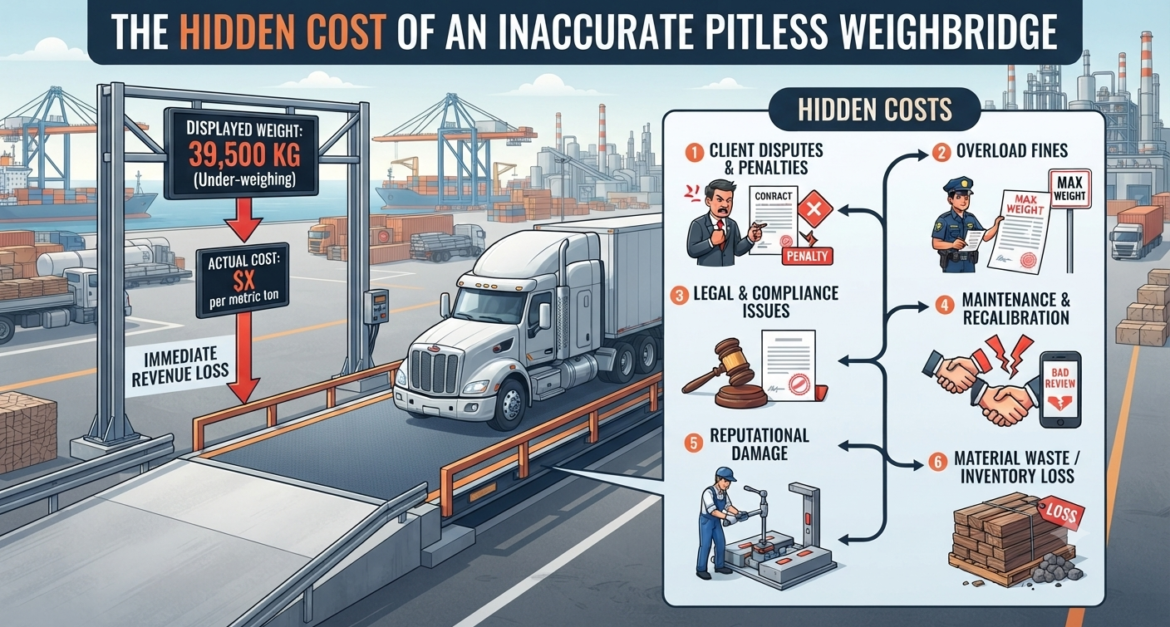
However, one major fear of business disregard is assessing precision. Additionally, a small blunder in a pitless weighbridge can cause financial losses, supply differences, customer differences, and functional insufficiencies. Gradually, these surprise rates can dramatically affect company revenues. Determining these hazards helps companies make better choices when acquiring, maintaining, and transforming their commercial weighbridge systems.
Hidden Costs and Business Risks of Inaccurate Weighbridge Measurements
Revenue Loss from Under-Weighing
Under-weighing occurs when a pitless weighbridge documents a lower weight than the actual vehicle weighs. This means businesses can dispatch a great deal more items than they bill customers for, leading to direct income losses.
Example:
Real weight: 25,000 kg
Tape-recorded weight: 24,900 kg
Difference: 100 kg
When this error happens in many cars each day, the total financial loss can become substantial. Industries that handle sand, concrete, steel, coal, minerals, and farming products are specifically at risk.
Similarly, a tiny measurement disparity can progressively reduce business efficiency.
Over-Weighing and Customer Disputes
An unreliable, pitless weighbridge may record a higher weight than the actual weight. This can create disputes between suppliers, clients, and transportation organizations.
Typical impacts include:
Consumer concerns and settlement disputes
Recurring automobile and vehicle thinking about
Postponed item shipment
Loss of client self-worth
Damages to company collaborations
Accurate weight dimensions help firms preserve transparency and build resilient customer partnerships.
Regulatory and Legal Compliance Risks
Industrial weighbridges used for company acquisitions should adhere to appropriate Legal Analysis needs. A wrong or improperly verified pitless weighbridge can develop compliance issues.
Potential impacts include the following:
Regulative fees
Inspection-related problems
Suspension of business operations
Added calibration expenditures
Hold-ups in service deals
Preserving appropriate verification documents and guaranteeing prompt calibration aid solutions prevent unnecessary compliance dangers.
Inventory Management Problems
A pitless weighbridge is crucial for tracking inbound resources and outbound shipments. When weight dimensions are inaccurate, supply data might not reflect actual supply levels.
This can cause:
Incorrect supply estimations
Unanticipated thing shortages
Production prep job mistakes
Purchase inadequacies
Financial reporting variations
For making plants, storage rooms, and structures and building firms, precise evaluating is very important for keeping reliable supply tracking.
Operational Delays and Increased Transportation Costs
A wrong pitless weighbridge can decrease car movement due to the fact that vehicle drivers may need to repeat thinking about therapies to confirm the tape-recorded values.
Typical functional barriers consist of:
Increased truck waiting times
Traffic congestion near weighing places
Greater gas usage
Extra task costs
Lowered everyday automobile handling ability
A properly maintained pitless weighbridge helps enhance lorry operation and improve basic functional performance.
Hidden Maintenance and Repair Expenses
Business in a lot of cases hold off upkeep to reduced momentary expenditures. However, forgetting small issues can bring about costly repairs and unanticipated truck downtime.
Regular maintenance problems consist of the following:
Damaged or defective whole lots of cells
Loosened electrical connections
Junction box failures
Indication malfunctions
System deterioration
Framework negotiation
Cord problems and water accessibility
Normal analyses and precautionary upkeep aid in identifying these difficulties before they become significant device failures.
How Load Cell Problems Affect Pitless Weighbridge Accuracy
Load cells are among one of the most important elements of a digital pitless weighbridge. They form the basis of the weighing system and convert the weight into electrical signals that are fine-tuned by the digital indication.
A malfunctioning weighbridge cell can produce irregular readings and affect the overall performance.
Normal indicators include:
Unpredictable weight display screens
Various analyses for the same vehicle
Sudden variations in dimensions
Incorrect zero examinations
Routine calibration modifications
Routine lot-cell analyses help keep relied on thinking about performance and quit unanticipated useful concerns.
Why Regular Calibration Is Important
Calibration plays a significant role in maintaining the accuracy of a pit weighbridge. Consistent automobile activity, significant lots, ecological difficulties, and element wear can gradually impact reviewing efficiency.
Recommended Calibration Schedule
Usage Level
Advised Calibration Uniformity
Light usage
Every 6 months
Modest use
Every 3–4 months
Significant industrial use
Normal regular monthly or as recommended
Remember: These are essential precautionary upkeep recommendations, not legal calibration durations. Abide by ideal lawful analysis needs and manufacturer recommendations.
Normal calibration assists businesses in keeping routine dimensions, reducing weighing differences, and increasing confidence in service deals.
Choosing the Right Pitless Weighbridge Manufacturer
The accuracy and stamina of a pitless weighbridge trust its style, framework and building and building high quality, lots cells, electronic aspects, and setup requirements.
When choosing a trusted weighbridge manufacturer in Tamil Nadu, consider the following elements:
Premium quality and suitable-capacity lots of cells
Solid system building
Appropriate framework and plan
Trusted digital weighing systems
Weather-resistant electrical components
Calibration and maintenance help
Access to extra parts
Reputable after-sales treatment
Picking a premium, high-quality pitless weighbridge from a knowledgeable producer can minimize lasting maintenance costs and boost sensible stability.
Best Practices to Maintain Pitless Weighbridge Accuracy
Organizations can follow these preventive measures to stay clear of potential mistakes:
Organize regular calibration and verification.
Assess load cells and electrical connections.
Preserve the thinking about system cleanliness.
Have a look at drains and stay clear of water buildup.
Monitor unusual weight changes.
Train vehicle drivers to comply with the solution, considering therapies.
Shield analysis and solution documents.
Get in touch with certified remedy technicians whenever accuracy troubles take place.
Conclusion
The hidden cost of an inaccurate, pitless weighbridge can impact solutions with income losses, customer disagreements, supply inequalities, consistency concerns, and unexpected maintenance costs. These problems might show up little at first but nevertheless can generate substantial monetary problems with time.
Acquiring an excellent-quality pitless weighbridge, organizing routine calibration, and complying with preventative upkeep methods can increase assessing precision and shielded resistant organization earnings.
Frequently Asked Questions
1) Why may inaccuracies occur?
Damaged cells, incorrect calibration, electrical problems, imbalance, structural issues, and moisture.
2) How regularly should pitless weighbridges be calibrated?
Depending on usage, issues with equipment, and correct procedure. In large businesses, there may be a need for more regular checks and calibrations.
3) If a pitless weighbridge is inaccurate, could it cause losses?
Yes. It may cause revenue loss, loss of product, customer issues, and issues with inventory.
4) What is the purpose of load cells?
To measure the force applied to the weighbridge platform by the vehicle/truck. Load cells convert this mechanical force into an electrical signal. From this, weight can be measured.
5) What can a business do to increase the accuracy of the weighbridge?
Regular calibrations, checking load cells, regular maintenance, correct installation, and driver training can increase accuracy.
6) What advantages do pitless weighbridges have?
Vehicles can easily be driven onto, easily installed, and have efficient water drainage and easy maintenance. Due to these advantages, they can be appropriate in sectors where vehicles must be weighed regularly.
7) What sectors commonly utilize pitless weighbridges?
Pitless weighbridges are commonly used within the construction, mining, cement, agriculture, logistics, manufacturing, and transport industries. Accurate weighing of vehicles can take place in these sectors.
8) What is the difference between pitless weighbridges and pit weighbridges?
Pitless weighbridges sit on the surface; however, they have a gradient to allow vehicles to drive onto them. Pit weighbridges sit in a hole in the foundations, meaning vehicles can drive onto the weighbridge at ground level.
9) What is the life expectancy of a pitless weighbridge?
With good designs, pitless weighbridges can last a long time. Life expectancy will depend on the quality of design, frequency of use, weight taken, maintenance, and environmental conditions.
10) What factors should I consider when choosing a pitless weighbridge?
Maximum weight, platform size, quality of load cells, material, installation requirements, support with calibration, guarantees, and after-sales support.